

Understanding AI-powered audio & video processing
A step-by-step look at the pipeline that turns a meeting recording into a structured, searchable and queryable report.

Unitee Team
Product
Understanding AI-Powered Audio and Video Processing
Why is simple transcription actually a complex process?
Transforming a meeting, conference, webinar, interview, or any audio/video recording into an actionable report is much more than simply converting speech into text.
To produce high-quality results that can be archived, easily searched, and queried using artificial intelligence, several sequential processing steps are required. Each of these stages relies on specialized technologies, computational resources, and sometimes third-party services, which explains the overall cost of such a solution.
At the same time, these processing steps raise important questions regarding confidentiality, privacy, and data protection.
Note: Depending on project requirements and constraints, these tasks may be performed using different AI providers (OpenAI, Anthropic, Mistral, Gemini, AssemblyAI, Gladia, etc.) or by models deployed on private infrastructure.
Process Overview
Before diving into each individual step, the diagram below illustrates the complete workflow followed by an audio or video file within our solution. It highlights the various processing stages, from media ingestion to report generation and AI-powered conversational querying.
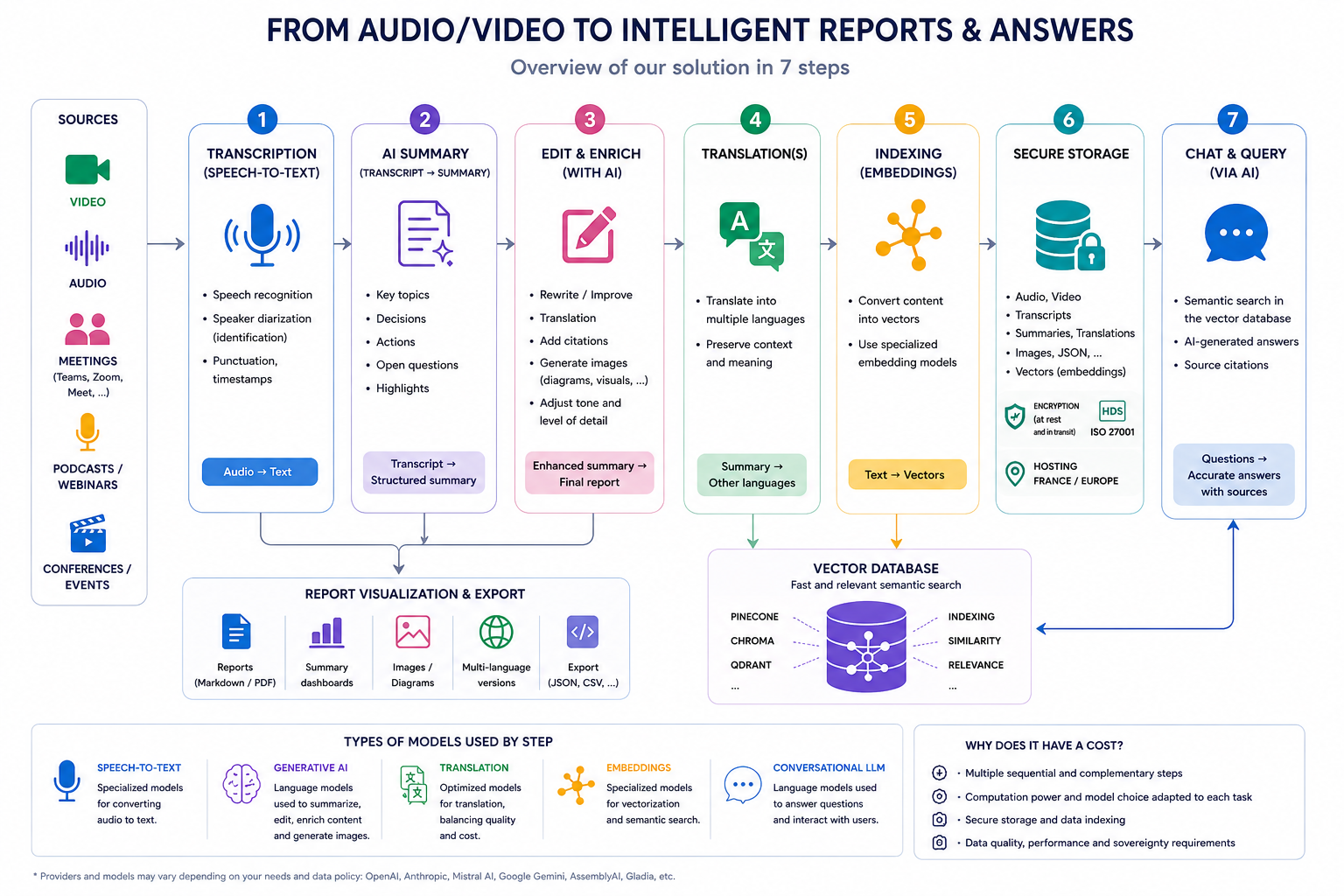
Step 1: Audio-to-Text Transcription (Speech-to-Text)
The first step is to convert audio or video content into text.
This operation is performed using Speech-to-Text (STT) engines capable of recognizing spoken language, identifying different speakers when applicable, and generating punctuation and timestamps.
Why does this step have a cost?
Processing audio or video files requires significant computational resources. The longer the recording or the lower its quality (background noise, overlapping speakers, strong accents, etc.), the more processing power is required.
Choosing the right transcription engine is also critical: some prioritize speed, while others focus on accuracy or advanced capabilities such as speaker diarization.
Step 2: Generating an Intelligent Summary
A raw transcript may span dozens or even hundreds of pages, making it difficult to consume efficiently.
The goal is therefore to generate a structured summary highlighting:
- Topics discussed
- Key decisions
- Action items
- Important takeaways
- Open questions
Why does this step have a cost?
This analysis requires a generative AI model capable of understanding context and synthesizing large amounts of information.
Depending on the desired quality level, it may be appropriate to use more or less powerful models, directly impacting processing time and cost.
Step 3: Editing and Enriching the Summary
The automatically generated summary can then be refined to better match user requirements.
For example, it can be used to:
- Rewrite or rephrase sections
- Add or remove information
- Adjust tone and level of detail
- Translate the summary into another language
- Add citations or excerpts from the transcript to support specific statements
- Automatically generate images, infographics, or explanatory diagrams based on the summary to illustrate concepts, workflows, or presentations
- Adapt the content for different audiences (executives, technical teams, customers, etc.)
This stage provides significant added value by allowing the final document to be customized without starting from scratch.
Step 4: Translation into Multiple Languages
In international environments, it may be necessary to produce the summary in one or more additional languages.
Modern AI models can generally preserve meaning, context, and nuances while providing fluent translations.
It is worth noting that translation tasks do not always require the most advanced language model available. In many cases, a smaller and more cost-effective model can deliver excellent results.
Step 5: Indexing for Semantic Search (Embeddings)
To enable users to ask questions such as:
- "What decisions were made regarding the budget?"
- "When was Project X discussed?"
- "Who is responsible for this action item?"
simply storing the text is not sufficient.
The content must be converted into mathematical representations known as embeddings (or vectors), which capture semantic meaning and enable intelligent search capabilities.
These vectors are then stored in a vector database (such as Pinecone, Chroma, or Qdrant) to quickly retrieve the most relevant passages.
Unlike summarization or translation, this stage relies on specialized embedding models rather than traditional conversational language models.
Step 6: Secure Data Storage
Once processing is complete, multiple assets must be preserved, including:
- Audio files
- Video files
- Transcripts
- Summaries
- Translations
- Metadata
- JSON files
- Embedding vectors used for search
These assets are typically stored within secure infrastructure featuring:
- S3-compatible object storage
- Encryption at rest and in transit
- Hosting in France or Europe
- Infrastructure compliant, when required, with standards such as HDS or ISO 27001
Step 7: Querying Reports with Conversational AI
Once indexed, users can interact with their reports using natural language, for example:
- "Summarize the key decisions."
- "What risks were discussed during the meeting?"
- "List all action items assigned to this team."
The system combines semantic retrieval from the vector database with a generative AI model to produce accurate, contextualized answers.
Why do these processes raise confidentiality concerns?
Depending on the chosen architecture, some data may be transmitted to external AI services to perform:
- Transcription
- Summarization
- Translation
- Embedding generation
- Conversational interactions
It is therefore essential to understand:
- Where the data is sent
- Where it is hosted
- How long it is retained
- What contractual guarantees providers offer
- What security measures are implemented
For sensitive information—such as strategic meetings, healthcare data, financial records, or intellectual property—these considerations require particular attention.
Why can the overall cost be significant?
Processing a video or audio recording involves a sequence of specialized operations:
- Speech-to-text transcription
- AI-generated summarization
- Content editing and enrichment
- Optional translation
- Embedding generation and indexing
- Secure storage
- Conversational search and question answering
An often-overlooked factor is the choice of AI model used for each stage.
Not every task requires the same level of intelligence:
- Transcription relies on specialized Speech-to-Text engines.
- Summarization and analysis may benefit from advanced generative models.
- Translation can often be performed using lighter, more cost-efficient models.
- Embeddings require dedicated vectorization models.
- Conversational search may use a different model depending on the desired quality and latency.
Selecting the most appropriate model for each task helps achieve the best balance between quality, performance, processing time, and operational cost.
Summary
Creating an intelligent report from audio or video content involves a chain of complementary technologies. Beyond transcription, the system must generate summaries, enrich content, translate it when necessary, index it for semantic search, and store it securely.
The success of such a solution depends not only on the quality of each processing stage but also on choosing the right models for each task and ensuring strong guarantees around confidentiality, security, and data protection.