
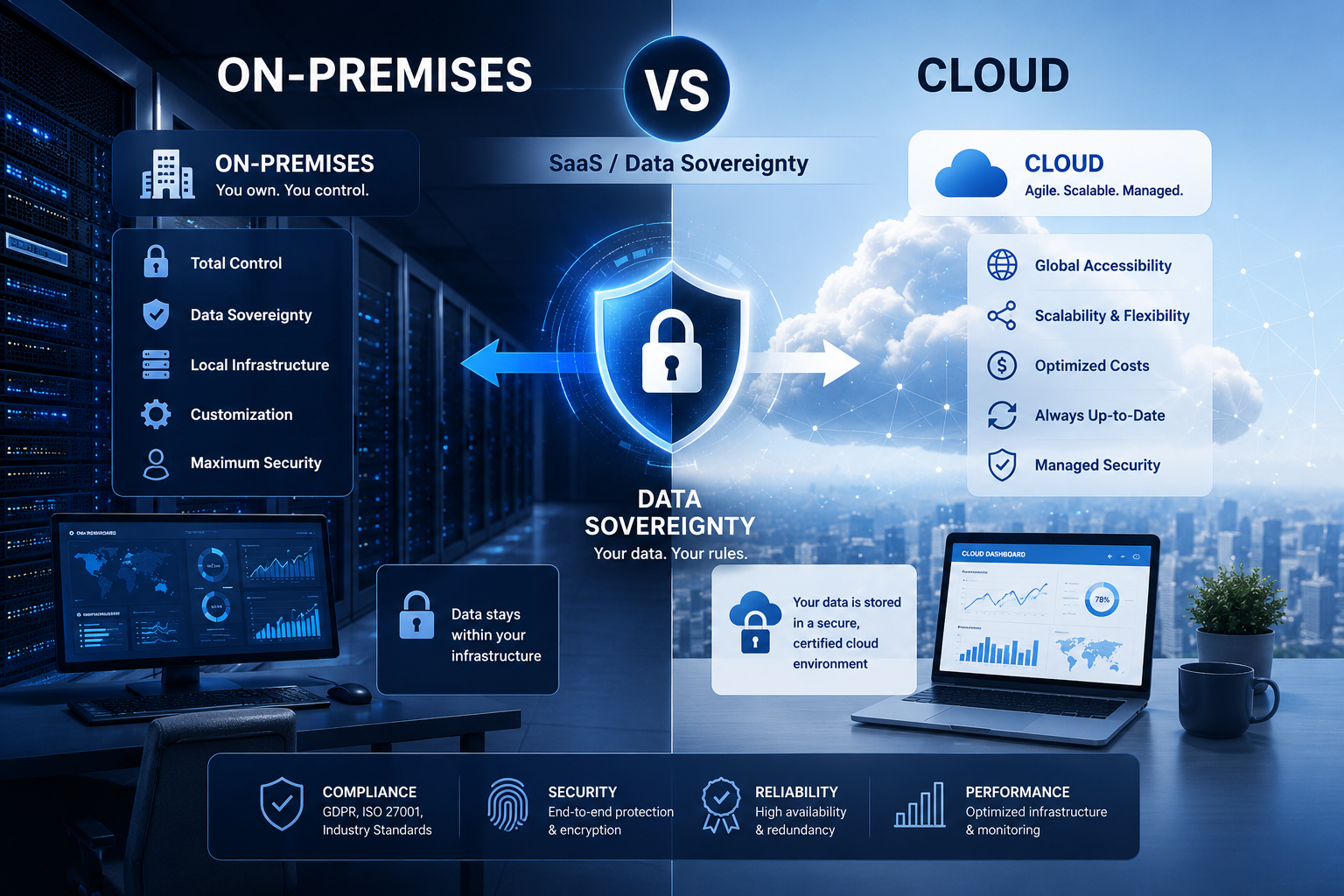
Data Sovereignty, Privacy, Security & Compliance
Data Sovereignty Without Compromise: Inside Our Cloud and On-Premise Models.

Unitee Team
Product
Introduction
In today’s digital economy, data has become one of the most valuable assets for businesses, governments, and individuals. As organizations increasingly rely on cloud computing, artificial intelligence, and global digital services, ensuring control over data has emerged as a critical challenge. Data sovereignty refers to the principle that data is subject to the laws and governance frameworks of the country or jurisdiction where it is collected, stored, or processed, while also emphasizing an organization’s ability to maintain control over its information.
The growing dependence on international technology providers has raised concerns about data privacy, security, regulatory compliance, and unauthorized access by foreign authorities. As a result, governments and enterprises are placing greater emphasis on keeping sensitive information under trusted legal and operational frameworks to reduce risks and protect strategic interests.
Data sovereignty is therefore becoming a key component of digital transformation strategies. By ensuring that data remains secure, compliant, and under appropriate control, organizations can strengthen trust, meet regulatory requirements, and preserve their digital autonomy in an increasingly interconnected world.
Cloud or On-Premise? How We Built Two Deployment Models Around Data Sovereignty
When your platform turns hours of meetings, calls, and recordings into searchable transcriptions and reports, you inherit one of the most sensitive responsibilities in software: someone else's words. A board discussion, a patient consultation, a legal deposition, an internal strategy call — these are not just files. They are data that organizations are legally and ethically obligated to protect.
That responsibility is exactly why we don't offer a single, one-size-fits-all deployment. We offer two — Unitee and Enterprise — built around the same AI engine but designed for very different data governance realities. Here's how they work, and how to know which one fits your organization.
Two models, one promise
Both deployment models deliver the same product experience: high-quality transcription, multilingual translation, semantic search, and automated reporting across audio and video, including native agents for Teams, Google Meet, and Zoom.
What changes between them isn't what the AI can do. It's where your data lives and who controls the infrastructure it runs on.
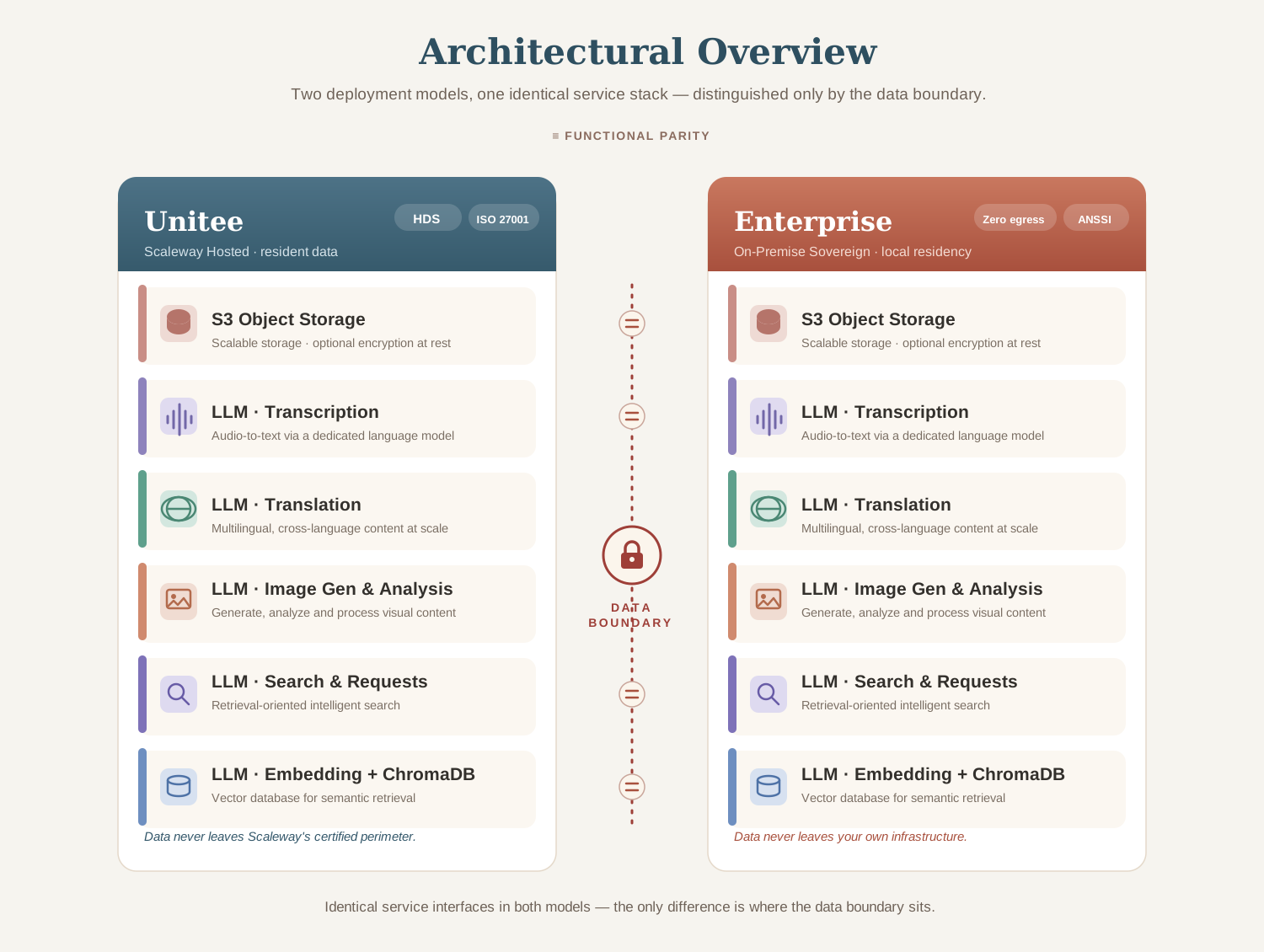
Unitee — Scaleway Hosted
With Unitee, all data and AI processing are hosted and managed exclusively on Scaleway infrastructure. It's compliant with HDS (Hébergeur de Données de Santé — France's certification for hosting health data) and ISO 27001, the international standard for information security management.
Unitee is built for organizations that want certified, sovereign-grade cloud infrastructure without the burden of managing hardware themselves. Scaleway handles physical and network security under a shared-responsibility model, while your data stays processed and stored exclusively within Scaleway's certified French data centers.
Enterprise — On-Premise Sovereign
With Enterprise, everything runs entirely within your own infrastructure. No data ever leaves your organization's perimeter — zero data egress, by design.
This model is built for regulated and high-security environments that require full data sovereignty and complete control over every processing pipeline. You own the entire stack: hardware, network, and software. It's compatible with internal security policies, ANSSI guidelines, and sector-specific regulations, and it can even be deployed in fully air-gapped, isolated environments for maximum isolation.
A shared service stack — true functional parity
Here's the part that matters most for engineering and product teams: both models run the exact same six service categories. There is no "lite" version. Whether you choose cloud-hosted or on-premise, you get identical capabilities:
- S3 Object Storage — a scalable object storage layer, with optional encryption at rest for sensitive assets.
- LLM Transcription — audio-to-text conversion powered by a dedicated large language model.
- LLM Translation — a multilingual engine for processing cross-language content at scale.
- LLM Image Generation & Analysis — a dedicated model for generating, analyzing, and processing visual content.
- LLM Search & Requests — query handling and intelligent search powered by a retrieval-oriented LLM.
- LLM Embedding + ChromaDB — embedding generation feeding a ChromaDB vector database for semantic retrieval.
This functional parity is intentional. We didn't want customers to trade capability for compliance, or compliance for capability. Both environments expose identical service interfaces — the only real distinction is the data boundary.
The data boundary is the whole point
It's worth stating plainly, because it's the single decision that drives everything else:
- With Unitee, your data never leaves Scaleway's certified perimeter.
- With Enterprise, your data never leaves your own infrastructure.
Same architecture. Same AI. Different perimeter. Two organizations could run completely identical workloads through completely different sovereignty models — and that's by design.
Compliance, side by side
Unitee — Scaleway certifications
- HDS certification for hosting health data in France
- ISO 27001 information security management
- Data processed and stored exclusively within Scaleway's certified data centers
- Shared-responsibility model: Scaleway manages physical and network security
Enterprise — sovereign control
- 100% on-premise with zero data egress outside your perimeter
- Full ownership of hardware, network, and software stack
- Compatible with internal security policies, ANSSI guidelines, and sector-specific regulations
- Air-gapped deployments possible for maximum isolation
How to choose
The choice between Unitee and Enterprise comes down to your regulatory constraints, operational maturity, and how much infrastructure control you want to retain.
Choose Unitee if:
- You require HDS- or ISO 27001-certified hosting.
- You prefer managed infrastructure with reduced operational overhead.
- You operate in healthcare or a regulated sector that needs certified cloud.
- Scaleway's French sovereignty guarantees already satisfy your data residency requirements.
Choose Enterprise if:
- Full data sovereignty is a non-negotiable requirement.
- Your organization must retain physical control of all infrastructure.
- You operate in defense, critical infrastructure, or another high-security sector.
- Air-gapped or isolated deployment environments are required.
The bottom line
Both models are architecturally equivalent in terms of AI service capabilities. The decision isn't about features — it's about data governance and compliance posture.
That's a deliberate philosophy. We believe organizations shouldn't have to weaken their security or sovereignty commitments to adopt modern AI. Whether your data sits in a certified French cloud or never leaves your own walls, the intelligence layer is the same. You decide where the line is drawn.
If you'd like to talk through which model fits your compliance environment, our team is happy to walk through it with you.